


Some of the greatest guitarists in history never studied music theory formally. Yet they created iconic riffs, unforgettable solos, and music that inspired generations.
So here’s the question: Do you actually need music theory to become a great guitarist?
It’s one of the most debated topics in the guitar community. Some players swear by it. Others believe that learning theory takes away from creativity and feel.
But here’s the truth: Music theory isn’t a set of rules telling you what to play. It’s a way of understanding why music works.
You can absolutely become a great guitarist without formal theory training. But understanding how chords, scales, and notes connect can help you navigate the fretboard, improvise with confidence, and express your musical ideas more freely.
And the best part? You don’t need to spend years studying textbooks to get started.
You just need to understand a few fundamental concepts and learn how to apply them to the guitar.

By the way, if you’re new here, I’m Jon, founder of University of Rock. I started studying music theory during my senior year of high school and continued throughout guitar college in Hollywood, California. Over the years, I’ve come to appreciate that the real value of music theory isn’t memorizing rules. It’s understanding your instrument well enough to play with more freedom and creativity.
In this article, I’ll share what I’ve learned about music theory, why it matters for guitarists, and how you can start applying it to your own playing.
Do You Actually Need Music Theory to Play Guitar?
The short answer? No. But understanding music theory can make you a more confident, versatile, and creative guitarist.
You don’t need to understand scales, intervals, or chord construction to learn your favorite riffs, play songs, or even write your own music.
Plenty of guitarists develop their skills through listening, experimenting, and learning by ear. Over time, they begin recognizing musical patterns naturally, even if they don’t know the technical names behind them.
But there’s an important distinction between knowing how to play something and understanding why it works.
For example, you might know how to play a minor pentatonic scale. But do you understand why certain notes sound great over a chord progression while others create tension?
That’s where music theory becomes valuable.
Instead of simply memorizing shapes and patterns, music theory helps you understand the relationships behind them.
Understanding music theory can help you:
- Navigate the fretboard by recognizing how notes, chords, and scales connect.
- Improvise with confidence by understanding which notes work over different chords.
- Write better music by exploring chord progressions, melodies, and harmony.
- Learn songs faster by recognizing familiar musical patterns.

Music Theory Is a Tool, Not a Rulebook
One of the biggest misconceptions about music theory is that it limits creativity.
In reality, music theory describes how music works. It doesn’t dictate what you’re allowed to play.
Think of it like learning a language. You can communicate without understanding grammar, but knowing how sentences are constructed gives you more ways to express yourself.
The same principle applies to guitar.
Music theory gives you a deeper understanding of your instrument, helping you make more intentional musical choices without sacrificing your creativity or personal style.
The goal isn’t to replace your ears with theory. It’s to give your ears more tools to work with.
Famous Guitarists Who Learned Without Formal Music Theory
Some of the most influential guitarists in history developed their signature sounds without following a traditional path of formal music education.
Rather than relying on textbooks or classroom instruction, they learned through listening, experimenting, and countless hours with their instruments.
Here are three legendary examples.
Jimi Hendrix
Widely regarded as one of the most innovative electric guitarists of all time, Jimi Hendrix was largely self-taught and couldn’t read standard musical notation.
Yet his playing demonstrated an extraordinary intuitive understanding of rhythm, harmony, and the expressive possibilities of the guitar.
From his distinctive chord voicings to his groundbreaking improvisation, Hendrix showed that musical understanding doesn’t always come from formal education.
Eric Clapton
Eric Clapton developed much of his musical foundation by listening to and studying blues guitarists, including Robert Johnson, B.B. King, and Freddie King.
His approach emphasized phrasing, feel, and ear training rather than academic theory.
Through years of playing and listening, Clapton developed a sophisticated musical vocabulary rooted in the blues.
Eddie Van Halen
Eddie Van Halen transformed rock guitar through experimentation, technical innovation, and a highly developed musical ear.
Although he received classical piano training as a child, his approach to guitar was largely self-directed.
His groundbreaking techniques and inventive compositions demonstrate how creativity, experimentation, and musical intuition can work together.
The Important Distinction: Formal Training vs. Musical Understanding
There’s a common misconception that guitarists who never studied music theory formally don’t understand theory at all.
But that’s not necessarily true.
A guitarist might not know the technical name for a particular chord or interval, yet still understand how it sounds and when to use it.
Musical intuition is often a form of practical theoretical understanding, even when a player can’t explain it academically.
The takeaway isn’t that music theory is unnecessary. It’s that there are multiple ways to develop musical knowledge.
And for guitarists who want to accelerate that process, learning the fundamentals of theory can help connect the patterns their ears already recognize.
5 Ways Music Theory Makes You a Better Guitarist
Music theory isn’t just about memorizing scales or learning complicated terminology. It’s about understanding how music works so you can make better decisions on your instrument.
Whether you’re a beginner or an experienced player, here are five practical ways music theory can improve your guitar playing.
1. Understand the Fretboard Instead of Memorizing Shapes
Many guitarists learn scales, chords, and patterns as isolated shapes without understanding how they connect.
You might know five pentatonic positions, for example, but still feel lost when trying to move between them.
Music theory helps you recognize the relationships between notes, intervals, chords, and scales across the neck.
Instead of seeing disconnected patterns, you begin seeing one connected fretboard.
2. Improvise With More Confidence
Ever find yourself playing the same pentatonic licks over and over?
Understanding music theory can help you break out of that rut.
When you know how scales relate to the underlying chords, you can make more intentional note choices instead of relying entirely on familiar patterns.
For example, understanding chord tones allows you to:
- Target important notes when the chords change.
- Create tension and release with more control.
- Build melodic solos that follow the harmony rather than simply running through scales.
The result? Solos that sound more musical and less like scale exercises.

3. Write More Interesting Songs and Chord Progressions
You don’t need music theory to write a great song. But understanding harmony gives you more creative options.
Knowing how chords are built and how they function within a key helps you experiment with different progressions, melodies, and moods.
For example, you can explore why certain chord changes create a sense of resolution while others leave the listener wanting more.
Theory doesn’t write the song for you. It gives you more possibilities to explore.

4. Learn Songs Faster and Recognize Musical Patterns
When you understand basic music theory, songs often become easier to learn and remember.
Instead of treating every chord progression as something completely new, you start recognizing familiar relationships.
For example, the I–V–vi–IV progression appears in countless popular songs.
In the key of C major, that’s:
C – G – Am – F
Once you recognize that pattern, you can understand how the same progression works in other keys.
Rather than memorizing everything from scratch, you’re learning to recognize the musical structure behind the song.
5. Communicate Better With Other Musicians
Music theory gives musicians a shared language.
Imagine you’re rehearsing with a band and someone says:
“Let’s move that progression to G major and add a dominant seventh before the chorus.”
Without some theory knowledge, that instruction might sound confusing.
But when you understand keys, chord functions, and common musical terminology, communicating ideas becomes much easier.
This is especially valuable when collaborating, recording, performing live, or working with musicians who play different instruments.
You don’t need to become a theory expert. Even a basic understanding can make you a more adaptable musician.

Why Guitarists Struggle With Music Theory
If you’ve ever tried learning music theory and felt overwhelmed, you’re not alone.
For many guitarists, the problem isn’t that music theory is too difficult. It’s that theory is often taught in a way that feels disconnected from actually playing guitar.
Traditional music education frequently introduces concepts through sheet music, abstract terminology, and exercises that don’t immediately translate to the fretboard.
And while those methods can be valuable, they aren’t always the most intuitive starting point for guitarists.
The Problem With Memorizing Disconnected Shapes
One of the biggest challenges guitarists face is learning patterns without understanding how they relate to each other.
Think about how most players approach the fretboard.
You learn a few open chords. Then some barre chords. Eventually, you memorize pentatonic scale positions, major scale patterns, and maybe a handful of arpeggios.
But here’s where things get frustrating.
You know the shapes, but you don’t necessarily understand how they connect.
This can leave you feeling stuck in familiar positions, even after years of playing.
Some common signs include:
- Getting lost on the fretboard when moving outside familiar positions.
- Playing the same licks repeatedly because you rely on memorized patterns.
- Struggling to connect chords and scales when improvising.
- Knowing what to play but not why it works.
The issue isn’t that learning shapes is wrong. Guitar is a visual instrument, and patterns are an essential part of learning it.
The problem is learning those patterns in isolation.
Music Theory Makes More Sense When You Can See It
Unlike a piano, where notes are arranged in a straightforward sequence, the guitar fretboard contains repeating note patterns across six strings.
The same note can appear in multiple locations, and the same chord can be played using different shapes and voicings.
That’s part of what makes guitar so versatile, but it can also make the instrument confusing.
The key is learning to connect theoretical concepts directly to the fretboard.
When you can visualize how chords, scales, intervals, and arpeggios overlap, music theory becomes much more practical.
Instead of memorizing dozens of unrelated patterns, you begin recognizing the underlying relationships that connect them.
And that’s where a visual framework like the CAGED system can make a significant difference.
Connect the Fretboard

See how chords, arpeggios & scales connect across the fretboard.
*No spam. Unsubscribe anytime.
The Music Theory Every Guitarist Should Learn First
You don’t need to master every concept in music theory to become a better guitarist.
In fact, trying to learn everything at once is one of the fastest ways to feel overwhelmed.
The best approach is to focus on a handful of fundamental concepts that directly improve how you understand and play the guitar.
Here are five essential areas worth learning first.
1. Musical Intervals
An interval is simply the distance between two notes.
Intervals are the building blocks of melodies, chords, and scales. Understanding them helps you recognize why certain notes sound stable, while others create tension.
For example:
- Root (1): The note that establishes your tonal center.
- Major third (3): Helps give major chords their bright, uplifting quality.
- Perfect fifth (5): Creates a strong, stable sound commonly heard in power chords.
- Minor seventh (♭7): Adds the distinctive character found in dominant seventh chords.
Once you understand intervals, chord shapes and scale patterns start making much more sense.
2. The Major Scale
The major scale is one of the most important foundations of Western music theory.
It provides the framework for understanding keys, chord construction, harmony, and countless melodies.
The major scale follows a specific pattern of whole steps and half steps:
Whole – Whole – Half – Whole – Whole – Whole – Half
For example, the C major scale contains:
C – D – E – F – G – A – B
Learning how this pattern works across the guitar fretboard gives you a foundation for understanding other scales and musical relationships.
3. How Chords Are Built
Instead of memorizing every chord shape individually, learn how chords are constructed from intervals.
For example, a basic major chord contains three notes:
Root (1) + Major Third (3) + Perfect Fifth (5)
A minor chord uses a slightly different formula:
Root (1) + Minor Third (♭3) + Perfect Fifth (5)
That one-note difference changes the character of the chord.
Once you understand these formulas, you can begin recognizing chord tones within familiar guitar shapes and even build your own voicings.
You’re no longer just memorizing where to put your fingers. You’re understanding what you’re actually playing.

4. Chord Progressions and Keys
A chord progression is a sequence of chords that creates movement within a song.
Understanding how chords relate to a key helps you recognize common patterns, learn songs, and experiment with songwriting.
For example, one of the most widely used progressions in popular music is:
I – V – vi – IV
In C major, that becomes:
C – G – Am – F
The Roman numerals describe each chord’s relationship to the key, allowing you to recognize and transpose the same progression into different keys.
This is especially useful when playing with other musicians or writing your own music.
5. Fretboard Visualization
Here’s where everything starts coming together.
You can understand intervals, scales, and chord formulas intellectually, but the real breakthrough happens when you can see those relationships on the guitar fretboard.
Instead of treating chord shapes, arpeggios, and scales as separate things, you begin recognizing how they overlap.
For example, within a single area of the fretboard, you can identify:
- Chord tones that outline the underlying harmony.
- Arpeggios that connect those chord tones melodically.
- Pentatonic scales that provide familiar improvisational patterns.
- Full scales that expand your melodic possibilities.
This ability to visualize musical relationships is one of the most practical applications of music theory for guitarists.
And it’s exactly what the CAGED system is designed to help you develop.

How the CAGED System Connects Music Theory to the Guitar
One of the biggest challenges with learning music theory is figuring out how to apply it to the guitar fretboard.
You might understand how chords are built or how scales work, but translating that knowledge into actual playing can still feel confusing.
That’s where the CAGED system comes in.
The CAGED system is a fretboard visualization method built around five familiar major chord shapes:
C – A – G – E – D
These shapes form a repeating framework that helps you understand how chords, arpeggios, and scales connect across the neck.
Instead of memorizing dozens of unrelated patterns, you begin seeing how different musical concepts fit together.

From Chord Shapes to a Connected Fretboard
Let’s say you’re playing an A major chord using an E-shaped barre chord at the fifth fret.
Within that same area of the fretboard, you can visualize:
- The A major chord tones: A, C♯, and E.
- The A major arpeggio: Those same chord tones played individually.
- The A major pentatonic scale: Five notes that create a familiar melodic framework.
- The A major scale: All seven notes of the key’s major scale.
These aren’t four completely separate concepts.
They’re different musical layers built around the same underlying harmony.
Once you understand how those layers overlap, you can move more naturally between rhythm playing, melodic fills, and improvisation.
Why Visualizing These Connections Matters
Imagine you’re playing a chord progression and want to add a short melodic phrase between chord changes.
Without a clear understanding of the fretboard, you might rely on a memorized lick or jump to a familiar scale position.
But when you can see the chord tones and surrounding scale notes, you have more options.
You can build phrases around the actual chords, target specific notes, and move between positions with greater confidence.
The goal isn’t to memorize more shapes. It’s to understand how the shapes you already know connect.
That’s the real value of combining music theory with the CAGED system.

A Visual Way to Learn the CAGED System
If you’re a visual learner, having these relationships mapped out can make the process much easier.
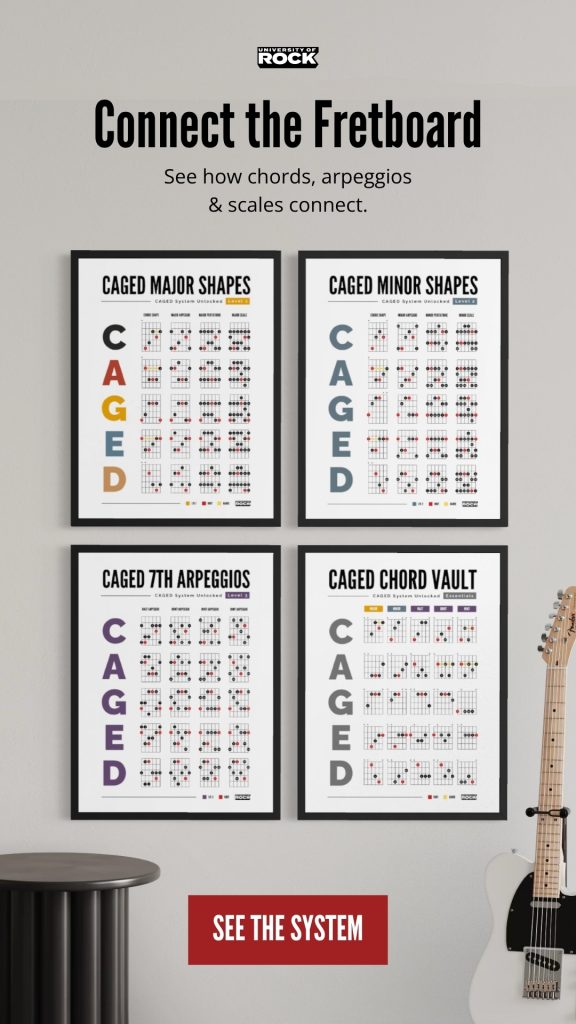
At University of Rock, we created our CAGED System Guitar Posters to help guitarists see how chord shapes, arpeggios, pentatonic scales, and full scales connect across the fretboard.
Rather than studying each concept in isolation, you can use the diagrams to explore how the different layers work together.
The collection covers major and minor CAGED patterns, seventh-chord arpeggios, and chord voicings, giving you a practical visual reference as you develop your fretboard knowledge.
Can You Learn Guitar Theory Without Reading Sheet Music?
Absolutely. You don’t need to read sheet music to understand music theory or become a great guitarist.
While reading musical notation is a valuable skill, it’s not the same as understanding how music works.
Music theory explains the relationships between notes, chords, scales, and harmony. Reading sheet music is simply one way of communicating that information.
How to Learn Guitar Theory Without Sheet Music
There are several practical ways to develop your understanding of music theory:
- Use fretboard diagrams to visualize chords, scales, and intervals.
- Train your ear to recognize musical patterns and relationships.
- Study real songs to understand chord progressions and harmony.
- Apply concepts directly through improvisation and practice.
For most guitarists, connecting what you see on the fretboard with what you hear and play is far more important than memorizing musical notation.
Sheet music can be useful, but it’s not a prerequisite for understanding your instrument.
If you’re a visual learner, our CAGED System Posters can help you put these concepts into practice by showing how chords, scales, and arpeggios connect across the fretboard.
Final Thoughts
So, do guitarists really need music theory?
No. But understanding it can make you a more confident, creative, and versatile musician.
You don’t need to memorize every scale, master complex harmony, or read sheet music to become a great guitarist.
What matters is learning enough theory to understand the music you’re playing and apply that knowledge to your instrument.
Start with the fundamentals. Learn how chords are built, how scales relate to them, and how those relationships connect across the fretboard.
Most importantly, don’t let theory replace your creativity. Let it expand it.
And if you believe music theory should inspire creativity rather than limit it, our “I Learned Music Theory So I Could Ignore It More Intelligently” wall art captures that philosophy perfectly.

FAQ About Guitar Music Theory
Can You Become a Good Guitarist Without Music Theory?
Yes. Many successful guitarists developed their skills primarily through listening, practicing, and learning by ear. However, understanding basic music theory can help you navigate the fretboard, improvise, and communicate musical ideas more effectively.
How Much Music Theory Should a Beginner Guitarist Learn?
Start with the fundamentals: musical intervals, the major scale, basic chord construction, and common chord progressions. Focus on applying each concept to the guitar rather than memorizing terminology.
Is the CAGED System Considered Music Theory?
The CAGED system is a fretboard visualization framework that helps guitarists apply music theory. It connects familiar chord shapes with arpeggios, scales, and intervals across the neck.
Do Professional Guitarists Use Music Theory?
Many professional guitarists use music theory, whether through formal training or an intuitive understanding developed through experience. Even players who don’t use technical terminology often recognize musical patterns and relationships by ear.
How Long Does It Take to Learn Basic Guitar Music Theory?
You can begin understanding fundamental concepts within a few weeks of consistent practice. Developing the ability to apply those concepts naturally across the fretboard takes longer and improves with experience.
The key is to learn a concept, apply it to your guitar, and gradually build on that knowledge.


